
'We will have to wait for one more year to cross the 7% mark, which should be possible in the absence of any disruptive reform,' points out CARE Ratings Chief Economist Madan Sabnavis.

Comparative to other Asian GDP growths, India would have the fastest economic expansion, it said
The International Monetary Fund and the World Bank had forecast that India's economy would grow at 8 per cent and 9 per cent, respectively.

Tata Steel was the top gainer in the Sensex pack, rallying 3.23 per cent, followed by SBI, Yes Bank, Hero MotoCorp, ICICI Bank and Bharti Airtel.

S&P Global Ratings on Wednesday said the second wave of COVID infections poses downside risks to India's GDP and heightens the possibility of business disruptions. The second wave brings in uncertainty and a drawn-out COVID outbreak will impede India's recovery, it said.
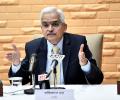
Key lending rate (repo) raised by 50 basis points to 4.9 per cent; 2nd increase in 5 weeks

This is mainly due to GST impact on manufacturing and subdued farm output.

ADB, however, has cut its growth forecast for developing Asia to 6.1 per cent from the earlier 6.3 per cent in view of subdued economic activity in the US and China.

The Budget should undertake further reductions in import tariffs and seriously consider an announcement of India's intention to join one or both of the two Asian mega-regional free trade agreements, suggests Shankar Acharya, former chief economic adviser to the Government of India.

Days after Moody's cut its gross domestic product (GDP) forecast for financial year 2022-23 (FY23) after the official GDP print for the June quarter came in lower than expectations, the global ratings agency said it would maintain its long-term sovereign debt credit rating and outlook on Asia's third-largest economy. "The credit profile of India reflects key strengths, including its large and diversified economy with high growth potential, a relatively strong external position, and a stable domestic financing base for government debt," Moody's said on Tuesday. "We do not expect rising challenges to the global economy, including the impact of the Russia-Ukraine military conflict, higher inflation, and the tightening financial conditions on the back of policy tightening, to derail India's ongoing recovery from the pandemic in 2022 and 2023," it said.

"A significant decline in the growth number for this quarter is highly likely, but for the fiscal year as a whole the decline may still be relatively moderate," Fitch Asia-Pacific Sovereigns Group Director Thomas Rookmaaker said.

'The numbers are null and void now. Look, we can give out projections now, but we know that a week later those numbers will also be irrelevant. So we need to wait,' a top government official said.

Defence exports grew 33 per cent in the calendar year 2023 (CY23) to around Rs 21,083 crore while domestic defence orders serviced by listed companies were Rs 48,000 crore. The sector is poised for steady growth. Budgeted domestic capex is likely to hit Rs 3 trillion per annum, and exports could reach $6 billion by FY29.
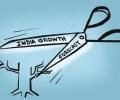
India's economy is projected to slow to 6.5 per cent in the fiscal year starting April but will remain the fastest growing major economy in the world as it fared better in dealing with the extraordinary set of challenges the globe has faced, the Economic Survey 2022-23 said on Tuesday. India's gross domestic product (GDP) growth of 6.5 per cent in 2023-24 compares with an estimated 7 per cent expansion in current fiscal year (April 2022 to March 2023) and 8.7 per cent in the previous year. Like the rest of the world, India too faced an extraordinary set of challenges in tightening financial conditions and supply chain disruptions from a prolonged war in Europe but "withstood them better than most economies", the annual document detailing the state of the economy said.

Indian economy is expected to clock an average growth rate of 6.7 per cent till 2026-27 fiscal driven by domestic consumption, S&P Global Ratings senior Economist (Asia Pacific) Vishrut Rana said on Wednesday. He said the economic growth in the current fiscal is expected to come in around 6 per cent, lower than 7.2 per cent clocked in 2022-23. "We are seeing some headwinds from the trade side which is affecting activity and that is one of the factors that is affecting growth this year," Rana said at a webinar.

Most forecasts do not have a track record of transparency and accuracy
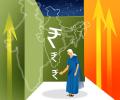
NITI Aayog member Arvind Virmani on Monday said India is set to become the fourth largest economy in the world by the end of 2025, an assertion which came days after NITI CEO BVR Subrahmanyam claimed India has already overtaken Japan to reach that spot. The International Monetary Fund (IMF), in its World Economic Outlook (WEO) report released in April had said that India is expected to be the fourth largest economy in the world with a GDP of $4.19 trillion in 2025, ahead of Japan.

Let's take a look at how India and world's major economies will perform in the next four years.

Fitch Ratings on Tuesday said the FY25 Budget demonstrated the government's ongoing commitment to reducing fiscal deficit and ensured policy continuity during the NDA government's new term. Finance Minister Nirmala Sitharaman on Tuesday presented the first Budget of the Modi 3.0 government in which she revised the deficit target for current fiscal lower to 4.9 per cent of the GDP, from 5.1 per cent projected in the interim Budget.

Moody's said it expects exposure to low oil prices to shave off 0.8 per cent from real GDP growth on average across oil exporting countries in 2016.

The report further said that confidence is improving, while risk aversion is falling and has upgraded industrial production to neutral from negative.

Projecting acceleration in India's GDP growth to 9% for FY 2011-012, Economic Advisory Council to Prime Minister seeks measure to address serious supply bottlenecks.
Our stock markets will remain volatile for a while and upswings could be followed by a downturn.

The growth in the contact-intensive portion of the economy trailed our expectation, highlighting how imperative it is for confidence to improve, either through accelerated vaccinations or otherwise, to drive a sustainable recovery in these sectors, asserts Aditi Nayar.

Days after keeping India's rating at lowest investment grade for 13th year in a row, the rating agency in a webinar said despite the contraction in GDP this year, the country continues to be an outperformer among the peer groups.

The Trump trade shock is a chance to push long-overdue reforms, rather than tinker with tariffs to appease the US, suggests M Govinda Rao.

Tata Motors was the biggest loser in the Sensex pack, tumbling 2.47 per cent, followed by Reliance Industries (2.44 per cent), Maruti (1.84 per cent), SBI (1.76 per cent) and Bajaj Finance (1.23 per cent).

The RBI is fully aware that the high-cost loans and high indebtedness of the borrowers could pose financial stability risks, if not addressed by these NBFCs. Governor Shaktikanta Das has issued a stern warning, saying the RBI is closely monitoring these areas and will not hesitate to take appropriate action, if necessary, if the culprits don't opt for self-correction. Watch out for some action, soon, notes Tamal Bandyopadhyay.

Stressing that economic growth will only move upwards, the Reserve Bank of India Governor Shaktikanta Das on Friday pegged the GDP growth rate for the next financial year at 10.5 per cent, though a tad lower than the government's projection of 11 per cent. The projection is in line with the estimates in the Union Budget 2021-22 presented in Parliament earlier this week. The Economic Survey, tabled by the government in Parliament recently, has projected that the economy will grow at 11 per cent, up from an estimated historic decline of 7.7 per cent in 2020-21, on account of the COVID-19 pandemic.

Chief Economic Advisor (CEA) V Anantha Nageswaran on Thursday said describing India's recovery as 'K-shaped' was wrong as both rural and urban economies were recovering, albeit at different paces. Speaking to reporters at the Finance Ministry, Nageswaran said the gross domestic product (GDP) growth print for the recent October-December quarter (Q3FY23) will likely be revised upwards. "The notion of using the letter 'K' to denote urban and rural is somewhat wrong because it is almost as if one is growing and one is contracting. "I would say one segment's slope is more positive, and the other one slope is less positive but it is positive," Nageswaran said.
The government will announce the FY13 GDP numbers on May 30, where it expects the readings to be around 5.2 per cent.

Twelve of the 21 economists polled doubted whether the government could roll out the tax before the next fiscal year begins in April.
"We expect GDP growth to slow from 7.3 per cent year-on-year in July-September 2016 to 6.0 per cent in October-December 2016 and 5.7 per cent in January-March 2017," Nomura said in a research note.

India's economic growth prospects should remain strong over the medium term, with GDP expanding 6-7.1 per cent annually in fiscal years 2024-2026, S&P Global Ratings said on Thursday. In a report titled 'Global Banks Country-By-Country Outlook 2024', S&P said the banking sector's weak loans will decline to 3-3.5 per cent of gross advances by March 31, 2025, on the back of structural improvement, including healthy corporate balance sheets, tighter underwriting standards and improved risk-management practices. Interest rates in India are unlikely to rise materially, and this should limit the risk for the banking industry, it added.

The Reserve Bank on Tuesday said growth is expected to fall below 5 per cent in 2013-14 in absence of pick-up in manufacturing sector, but likely to recover to 5.5 per cent in the next financial year.

TCS was the biggest loser in the Sensex pack, sliding 3.17 per cent, followed by HCL Tech, Yes Bank, IndusInd Bank, RIL, ICICI Bank, Infosys, Tata Steel, Kotak Bank and L&T, down up to 2.34 per cent.

On Thursday, the UN pegged the calender 2013 growth at 6.4 per cent, while the ADB last projected that the domestic economy would reach 6 per cent in the current fiscal.
NCAER on Wednesday forecast a higher 8.13 per cent growth for 2003-04, but warned that fiscal deficit would shoot up to 6.1 per cent of GDP due to increased government expenditure and surging inflation.

The economy is likely to register a 9.5 per cent growth this fiscal over 7.3 per cent contraction last year, as the ongoing recovery is faster and more credible than earlier foreseen, according to a foreign brokerage report. It will gather more momentum in the second half of the current fiscal, but will slow down to 7.7 per cent next financial year, it added. The government has budgeted for a 10.5 per cent growth this fiscal, but the Reserve Bank has scaled it down to 9.5 per cent.

Among the Sensex firms, ITC, Kotak Mahindra Bank, ICICI Bank, Nestle, Axis Bank, IndusInd Bank, UltraTech Cement, Bajaj Finance, Maruti and HDFC Bank were the major laggards.
